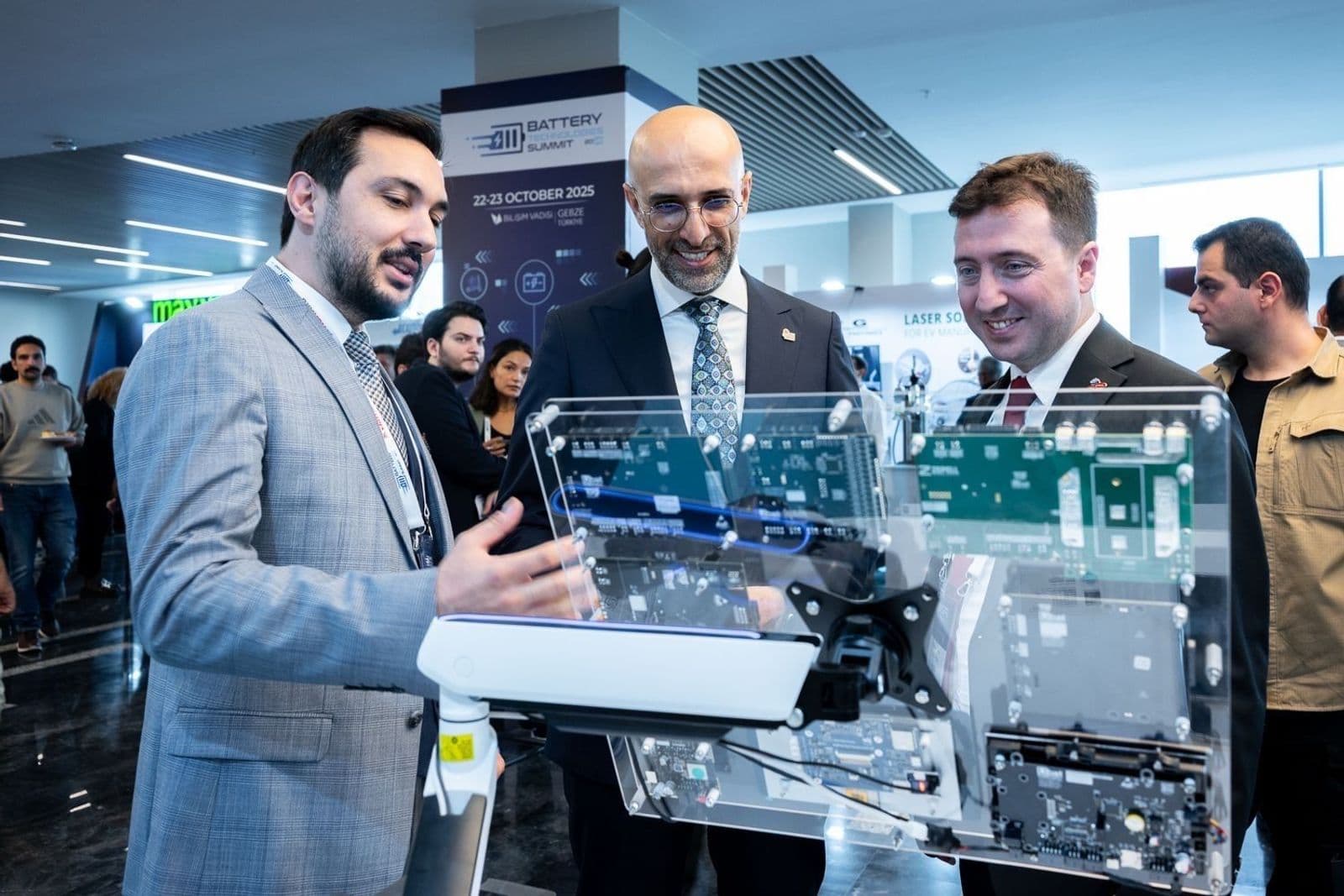
The Battery Technologies Summit 2025, held October 22 to 23 at Bilişim Vadisi in Gebze, brought together more than 750 participants and 35 speakers from across the global energy storage ecosystem [1]. Organized by PiLDER (the Battery Pack Manufacturers and Suppliers Association) in partnership with the Investment and Finance Office of the Presidency of the Republic of Türkiye, BTS is becoming the most important annual gathering for the Turkish battery industry [2].
For us, this wasn't just another event. It was a chance to present our work to both technical and business audiences on our home turf. Bilişim Vadisi is where our offices are.
Two Keynotes, Two Angles
S. Serkan Somer opened our contribution with a keynote on "Key Opportunities (and Challenges) for the Battery Industry in Türkiye." The presentation covered the macro forces driving battery adoption across transportation, renewables, and industrial automation [3], and made the case that Turkey's position in the European supply chain is more valuable than the domestic conversation typically acknowledges.
Tolga Baykal followed with a technically denser session: "Cloud-Aided Battery Management System Integration for Non-Automotive Applications." This walked the audience through the architecture of LiBat Connect and demonstrated how real-time telemetry, remote diagnostics, and over-the-air firmware update capabilities come together for warehouse AGVs, micro-mobility fleets, and stationary storage installations [4]. The audience was engaged, and the questions afterward ran well past the allocated time.
Why Non-Automotive Was the Right Topic
The global battery conversation centers on electric vehicles. But the point of Baykal's presentation was that non-automotive applications (warehousing, micro-mobility, telecom, energy storage) represent a larger addressable market for intelligent BMS solutions in many regions [5]. These sectors need wider temperature ranges, longer cycle life support, and the ability to manage distributed fleets with minimal on-site expertise.
The response confirmed something we'd been sensing from our order book: the demand for cloud-connected BMS outside of automotive is growing faster than most industry observers expect [6].
Conversations That Matter
Beyond the keynotes, BTS provided something presentations can't: hallway conversations. We talked with cell manufacturers about upcoming chemistry variants, with system integrators about their high-voltage scaling challenges, and with fleet operators about what they actually need from a monitoring dashboard (spoiler: it's simpler than most vendors think).
The networking also reinforced the importance of standards. With the EU Battery Passport deadline approaching in 2027 [7], interoperability and data standardization were recurring themes. Every serious conversation eventually circled back to: can your BMS collect and export the data that regulations will require?
What We Took Away
BTS 2025 confirmed that our direction, combining embedded hardware with cloud intelligence for non-automotive sectors, aligns with where the market is heading [8]. The conversations started in Gebze will shape our product and partnership decisions through 2026 and beyond. And having the event on our doorstep didn't hurt either.
References
- [1]Battery Technologies Summit 2025 — Official Event Page, Bilişim Vadisi, Gebze
- [2]PiLDER — Pil ve Batarya Üreticileri ve Tedarikçileri Derneği (Battery Pack Manufacturers and Suppliers Association)
- [3]Presidency of the Republic of Türkiye Investment Office — Energy and Renewables Sector Overview
- [4]LiBat — Configuration Tools: LiMon PC Tool, LiMon CONNECT, and LiBat CONNECT Mobile
- [5]BloombergNEF, Energy Storage System Costs Survey 2024 — Non-Automotive Battery Applications
- [6]LiBat — Battery Management Systems: Complete Product Lineup and Communication Interfaces
- [7]Regulation (EU) 2023/1542 — Digital Battery Passport Requirements
- [8]IEA, Global EV Outlook 2024 — Battery Demand Beyond Electric Vehicles